

On this page you can read about:
Peron Naturaliste Partnership
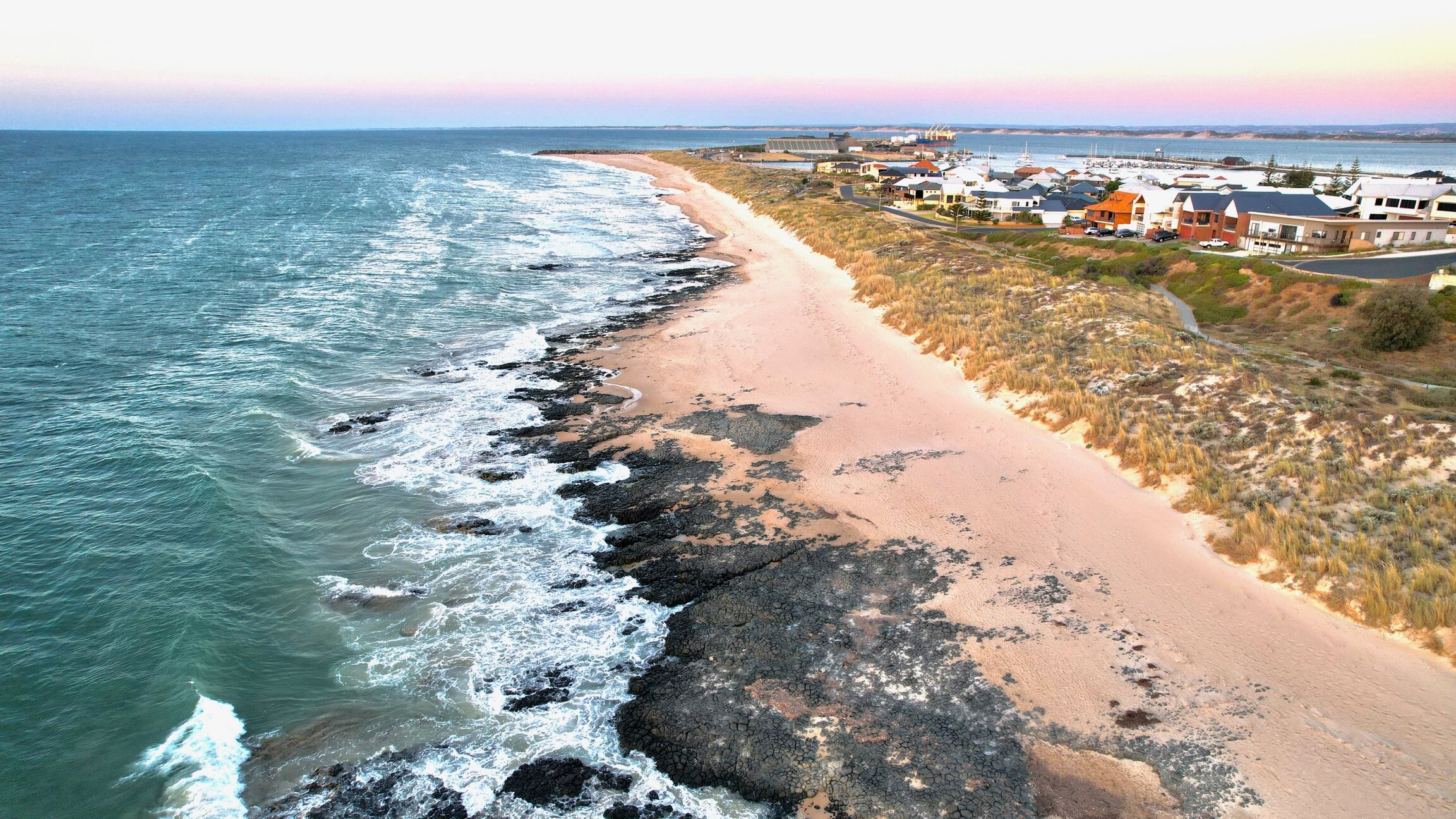
Our coast is highly valued providing us with places and spaces to live, do business, be active and enjoy.
However, the coast is mobile – it is constantly changing through storm events and the changes that humans make to the coastline.
There will also be further changes because of climate change, such as sea level rise and potentially more severe storm events. These coastal changes are now becoming much more noticeable and happening more rapidly. For this reason, local governments throughout Western Australia have been undertaking studies to understand the impacts of these coastal processes, particularly where people live.
Peron Naturaliste Partnership
City of Bunbury is a member of the Peron Naturaliste Partnership (PNP), which comprises the membership of nine local government authorities between Cape Peron and Cape Naturaliste in the South West of Western Australia – Bunbury, Busselton, Capel, Dardanup, Harvey, Mandurah, Murray, Rockingham, Waroona.
Through the City’s PNP membership, the City joined a Steering Group with the Shires of Capel, Harvey and Dardanup, Southern Ports Authority and the Department of Biodiversity, Conservation and Attractions to commission consultants to produce the Capel to Leschenault CHRMAP.
CHRMAP Development and Purpose
The City of Bunbury CHRMAP was developed as part of the Capel to Leschenault CHRMAP.
The purpose of the City of Bunbury CHRMAP is to provide strategic guidance for coordinated, integrated, and sustainable decision making for future coastal land use planning, including management or, and adaptation to, these coastal hazard risks.
The City of Bunbury CHRMAP describes risk management actions to be undertaken to achieve preferred risk treatments. Coastal hazard vulnerabilities were addressed by dividing the City’s shoreline into five management units, recommending adaptation pathways and options to manage the coastal erosion and inundation risk, to give preliminary direction for future investigations and funding opportunities.
Following this work, the intent is for the CHRMAP to be reviewed, and the recommended options will be updated to take the new information into consideration.
The draft CHRMAP was publicly advertised for 12 weeks (ending 16 June 2023) and the comments received were considered when finalising the City of Bunbury CHRMAP.
The final version of the City of Bunbury CHRMAP (below) was endorsed by Council at the OCM on 23 April 2024.
If you would like to receive updates on the CHRMAP please email us via the link below and we will add you to our database.
- Click the button below
- Scroll down to ‘send us a message’
- Fill in your details and include in the Message that you would like to be added to the CHRMAP newsletter

Current CHRMAP Actions
Metocean Data Collection Study
The City of Bunbury is measuring the ocean conditions off Back Beach to help us plan for coastal erosion and sea level rise. We're working with specialist coastal consultants who will place measuring instruments in the water off Back Beach. The instruments will collect information day and night for at least 12 months. Readings will be taken regularly, from every few minutes up to every half hour. That covers every season, from calm summer days to winter storms. This will give us a detailed record of the ocean conditions that shape this part of our coast.
"Metocean" is short for "meteorological and oceanographic". It means information about the weather and the ocean.
The instruments will record:
- Waves: height, direction, how often they arrive, and the difference between local wind waves and ocean swell
- Wind: speed, direction and gusts
- Currents: speed and direction at the seabed, at the surface and through the water in between
- Water levels: water depth and changes in water level over time
The study will give us:
- A detailed local record of ocean conditions: a full year of reliable information about the waves, wind, currents and water levels at Back Beach.
- A base for future coastal studies: the data will support later studies of how sand moves along our coast.
- Better predictions of shoreline change: the data will feed into computer models of how our shoreline could change, including with sea level rise.
- A fair way to compare options: we can compare coastal management options on an even footing, using the same reliable information.
This project is jointly funded by the Department of Transport and Major Infrastructure and the City of Bunbury.
FAQs: Metocean Data Collection
Our coastline faces growing risks from erosion and flooding as the climate changes. To manage these risks well, we need to understand what’s happening at Back Beach itself.
A full year of readings means future decisions will be based on real Bunbury conditions, not assumptions.
We expect that the main instruments will sit on the seabed in about 10 metres of water, so they’re unlikely to be visible from the beach. A small marker buoy may be needed for boating safety, and you may see a boat working off Back Beach when the instruments are installed, serviced and removed. Details will be confirmed once the consultant is appointed.
The instruments will be placed in deeper water, away from the main swimming area. Before anything goes in the water, the consultant must obtain all required approvals, issue notices to boaters, and choose a location and mooring method that limits disturbance to the seabed and marine life. We ask boaters and fishers not to anchor near, or disturb, any marker buoys.
Yes. The findings will also be provided to the Bunbury Artificial Reef Group to help with their investigations for a proposed reef.
The CHRMAP identified some areas that need more detailed study. Our Short-Term Coastal Action Plan sets out when we’ll do these studies over five financial years, from 2024 to 2025 through to 2028 to 2029. This metocean study is one of them.
CHRMAP Summary Report
The CHRMAP Summary Report has been developed to distil the technical CHRMAP information, to put it simply and graphically, and to include frequently asked questions and a description of how the community may be affected. The Draft CHRMAP Summary Report, in its current form, gives a comprehensive and detailed overview of the CHRMAP process that is helpful to read and understand.